Restaurant order throttling helps restaurants manage online orders when demand gets too high. In this post, we explain what order throttling is, why restaurants use order limits, how time slots work, and what happens when a slot reaches capacity. We’ll also cover how throttling differs from turning online ordering off and how Vouch POS helps restaurants handle busy periods.
In This Post
- What Is Restaurant Order Throttling?
- Why Do Restaurants Need Order Limits?
- Order Throttling vs. Turning Online Ordering Off
- How Order Limits Work
- What Happens When a Time Slot Is Full?
- Order Throttling Can Help During Unexpected Rushes
- What About Orders That Are Already in the System?
- Order Throttling Can Improve the Customer Experience
- How Vouch POS Helps Restaurants Manage Order Volume
- Frequently Asked Questions
- Keep Your Kitchen Busy-Without Overwhelming It
A busy restaurant is a good thing-until too many orders arrive at the same time.
During lunch and dinner rushes, restaurants may receive orders from their website, mobile app, phone, delivery channels, and walk-in customers all at once. When the kitchen receives more orders than it can realistically prepare, wait times increase, staff become overwhelmed, and customers may end up waiting longer than expected.
This is where restaurant order throttling and order limits can help.
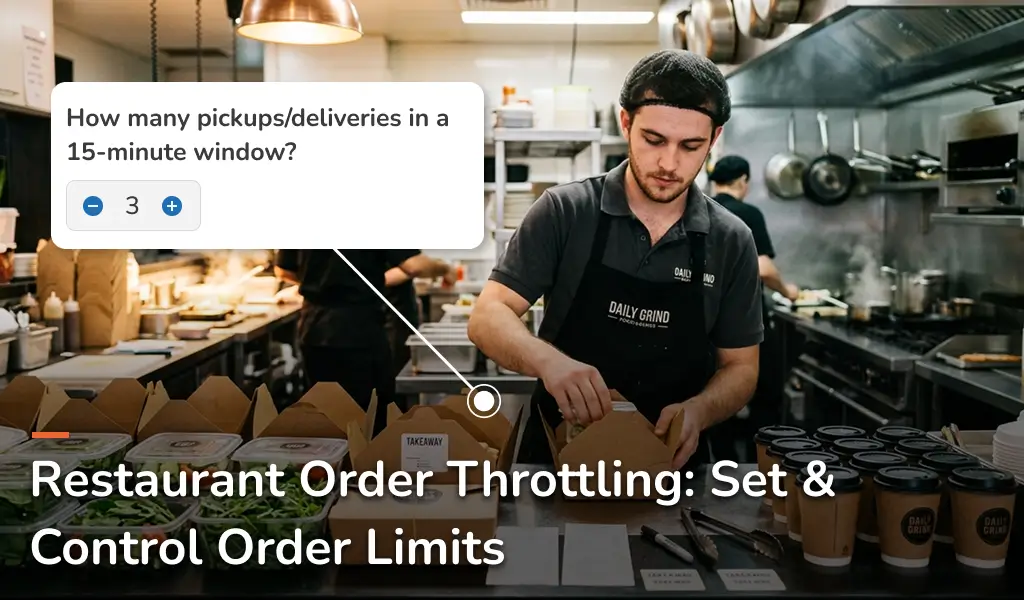
Order throttling allows a restaurant to control how many pickup and delivery orders it accepts within a specific time window. Instead of allowing unlimited orders for the same pickup or delivery time, the ordering system can automatically spread orders across available time slots.
The goal isn’t to stop taking orders. It’s to make the flow of orders more manageable for the kitchen.
What Is Restaurant Order Throttling?
Restaurant order throttling is a system that controls the rate at which a restaurant accepts incoming orders.
For example, suppose a restaurant’s kitchen can comfortably prepare five online orders every 15 minutes.
Without an order limit, customers could potentially select the same 15-minute pickup window and place 15 or 20 orders.
With order throttling enabled, the restaurant can limit the number of orders accepted during that period. Once the capacity is reached, customers can be offered the next available time slot.
For example:
- 12:00 PM – 5 orders available
- 12:15 PM – 5 orders available
- 12:30 PM – 5 orders available
- 12:45 PM – 5 orders available
If the 12:00 PM capacity is already full, a customer can choose 12:15 PM instead.
This creates a more predictable flow of orders for the kitchen.
Why Do Restaurants Need Order Limits?
Restaurant online ordering system has made it easier for customers to place orders, but it has also created a new operational challenge: order volume can increase much faster than kitchen capacity.
A restaurant might be able to handle 30 orders over an hour, but that doesn’t necessarily mean it can handle 30 orders arriving within five minutes.
The difference is important.
A kitchen needs time to:
- Receive the order
- Prepare the food
- Cook the food
- Package the order
- Stage it for pickup or delivery
- Hand it to the customer or driver
When too many orders arrive simultaneously, every step can become slower.
Order limits help distribute that workload.
Order Throttling vs. Turning Online Ordering Off
Order throttling doesn’t mean a restaurant has to stop accepting online orders.
There is an important difference between limiting orders and turning ordering off completely.
Order throttling
The restaurant is busy but can still accept orders.
For example:
“Our 12:30 PM pickup capacity is full. The next available time is 12:45 PM.”
Customers can continue ordering, but their orders are spread across available time slots.
Temporarily turning off ordering
The restaurant is temporarily unable to accept additional online orders.
This might happen because of:
- A major equipment problem
- Staff shortages
- An unusually large catering order
- An unexpected rush
- A kitchen emergency
- A temporary operational issue
In this situation, the restaurant may choose to temporarily stop accepting online orders altogether.
Both capabilities are useful, but they solve different problems.
How Order Limits Work
Order limits are generally based on a restaurant’s available capacity.
A restaurant might decide that it can comfortably handle:
5 online orders every 15 minutes.
That capacity can then be used to control the available pickup and delivery slots.
For example:
| Time Slot | Maximum Orders | Orders Already Accepted | Availability |
|---|---|---|---|
| Time Slot: 12:00 PM | Maximum Orders: 5 | Orders Already Accepted: 5 | Availability: Full |
| Time Slot: 12:15 PM | Maximum Orders: 5 | Orders Already Accepted: 3 | Availability: 2 available |
| Time Slot: 12:30 PM | Maximum Orders: 5 | Orders Already Accepted: 1 | Availability: 4 available |
| Time Slot: 12:45 PM | Maximum Orders: 5 | Orders Already Accepted: 0 | Availability: 5 available |
When a customer places an order, the ordering system checks the capacity for the selected time.
If capacity is available, the order can proceed.
If the selected slot is full, the system can offer another available time.
This is much more useful than simply rejecting the order.
Pickup and Delivery Orders Should Be Considered Together
One of the important considerations for restaurant order limits is that pickup and delivery orders both consume kitchen capacity.
Imagine a restaurant can comfortably prepare five orders every 15 minutes.
If the restaurant accepts:
- 3 pickup orders
- 2 delivery orders
that’s five orders.
But if pickup and delivery are managed completely separately, the system might allow five pickup orders plus five delivery orders during the same period.
That creates 10 orders for a kitchen that can comfortably handle only five.
For restaurants where pickup and delivery share the same kitchen, order limits should take the restaurant’s overall workload into account.
What Happens When a Time Slot Is Full?
A full time slot doesn’t necessarily mean the customer should lose the order.
Instead, the ordering system can guide the customer toward the next available time.
For example:
- 12:30 PM is currently full.
- Next available pickup time: 12:45 PM
- Would you like to continue with 12:45 PM?
This gives the customer a clear choice.
It also gives the kitchen additional time to work through existing orders before the next order arrives.
A well-designed ordering experience should make this process as clear as possible rather than leaving the customer wondering why their preferred time isn’t available.
A Simple Example
Consider a pizza restaurant during the Friday evening rush.
The restaurant determines that its kitchen can comfortably handle 10 online orders every 15 minutes.
At 6:00 PM, several customers place orders.
Within a few minutes, the 6:00 PM capacity is reached.
Without order throttling, additional customers might continue selecting 6:00 PM. The result could be:
- A large queue of orders
- Longer preparation times
- Delayed pickups
- Delivery delays
- More pressure on kitchen staff
- Customers waiting longer than expected
With order limits, the system can instead move customers toward the next available slots:
6:00 PM – Full
6:15 PM – Available
6:30 PM – Available
The restaurant continues accepting business while giving its kitchen time to process the existing workload.
Order Throttling Can Help During Unexpected Rushes
Restaurants don’t always know when a rush is going to happen.
A normally manageable Tuesday afternoon can suddenly become extremely busy because of:
- A local event
- Bad weather
- A promotion
- A nearby office lunch
- A sports event
- A large group ordering at once
- Unexpected staff availability issues
Order limits provide restaurants with another tool for managing these situations.
Instead of immediately turning online ordering off, the restaurant can reduce the number of orders accepted during each time window.
That can allow the restaurant to continue accepting orders while giving employees enough time to keep up.
Order Limits Are About Capacity, Not Just Time
It’s tempting to think of order throttling simply as:
“Only accept X orders every 15 minutes.”
But the underlying idea is really about kitchen capacity.
A restaurant serving simple items may be able to process a larger number of orders in a short period.
A restaurant preparing complex dishes may need considerably more time.
Similarly, capacity can change throughout the day.
A restaurant might have:
- More staff during lunch
- Fewer employees during late afternoon
- A larger kitchen team during dinner
- Different preparation times for different menu items
That’s why order limits should be treated as an operational tool rather than a universal number that works for every restaurant.
What About Orders That Are Already in the System?
An effective order-limiting system also needs to consider orders that have already been placed.
Suppose five customers have already selected a particular pickup window.
A sixth customer shouldn’t necessarily be treated as if the time slot were empty simply because the system is receiving a new request.
Existing orders contribute to the restaurant’s workload. A QSR POS system can help keep track of these orders and provide a clearer view of how much demand is already scheduled for a particular time period.
By considering orders that have already been accepted, the system can make better decisions about whether another order should fit into that time window or be moved to a later slot.
This helps prevent the restaurant from accidentally overbooking a busy period.
Order Throttling Can Improve the Customer Experience
At first, limiting orders might seem like a restriction for customers.
In practice, it can create a better experience.
Consider two scenarios.
Scenario A: Unlimited ordering
- The customer selects 6:00 PM.
- The restaurant accepts the order.
- The customer arrives at 6:00 PM.
- The kitchen is overwhelmed, and the order isn’t ready until 6:30 PM.
Scenario B: Controlled ordering
- The customer selects 6:00 PM.
- The restaurant has reached its capacity.
- The system offers 6:15 PM instead.
- The customer knows the expected pickup time before completing the order.
The second scenario creates a more predictable experience for both sides.
The restaurant gets a manageable workload, and the customer gets a more realistic expectation.
How Vouch POS Helps Restaurants Manage Order Volume
Vouch POS includes tools designed to help restaurants manage their ordering operations, including online ordering, pickup, delivery, and kitchen workflows.
With order limits, restaurants can control how many orders are accepted during a given time window.
When a particular time slot reaches its capacity, the ordering experience can offer a later available slot instead of continuing to overload the same period.
Importantly, order limits can account for both pickup and delivery orders, helping restaurants manage the total flow of online orders going into the kitchen.
Combined with a Kitchen Display System, these tools can help restaurants keep orders organized as they move from the ordering system to the kitchen. A KDS can display incoming orders for kitchen staff, help teams track order status, and make it easier to prioritize and manage orders during busy periods.
This can be particularly useful for restaurants that experience significant order volume during lunch, dinner, weekends, or other peak periods.
Order Throttling Doesn’t Replace Good Restaurant Operations
Order limits are a tool-not a replacement for good kitchen planning.
Restaurants should still consider:
- Average preparation times
- Kitchen staffing
- Menu complexity
- Equipment capacity
- Order volume
- Delivery times
- Pickup traffic
- Catering orders
- Peak periods
- Unexpected operational issues
The right order limit will depend on the restaurant.
A pizza shop, coffee shop, bagel shop, and full-service restaurant may all need different approaches to managing incoming orders.
The important thing is to match the ordering system to what the kitchen can realistically handle.
Frequently Asked Questions
What is order throttling in a restaurant?
Order throttling is a method of controlling the number of orders a restaurant accepts within a particular period. When a time slot reaches its capacity, customers can be directed to a later available slot.
What is a restaurant order limit?
A restaurant order limit is the maximum number of orders a restaurant chooses to accept within a defined time window. The limit is typically based on the restaurant’s kitchen and operational capacity.
Does order throttling mean a restaurant stops taking online orders?
No. Order throttling generally means that orders are spread across available time slots. A restaurant can continue accepting orders while controlling how many are scheduled for each period.
Should pickup and delivery orders have separate limits?
It depends on the restaurant’s operations. If pickup and delivery orders are prepared by the same kitchen team, combining them into an overall capacity can help prevent the kitchen from receiving more work than it can handle.
What happens when a restaurant reaches its order limit?
The ordering system can make the current time slot unavailable and offer the customer the next available time instead.
Can order limits help during a lunch or dinner rush?
Yes. Order limits can help spread incoming orders across multiple time windows, reducing the number of orders arriving simultaneously during busy periods.
How do I determine the right order limit for my restaurant?
Start with your actual kitchen capacity. Consider staffing, preparation times, equipment, average order volume, and the number of orders your team can comfortably complete within a given period. You can then adjust the limit based on real-world performance.

Keep Your Kitchen Busy-Without Overwhelming It
Online ordering should help restaurants grow their business, not create an operational bottleneck.
Order throttling gives restaurants a way to balance those two goals: continue accepting orders while keeping incoming demand aligned with kitchen capacity.
By controlling order volume, spacing out pickup and delivery orders, and offering customers the next available time when a slot is full, restaurants can create a more predictable ordering process for both customers and staff.
Vouch POS helps restaurants manage online ordering, pickup, delivery, kitchen operations, and more from one platform.
If your restaurant is receiving more online orders than your kitchen can comfortably handle during peak periods, order limits can give your team another way to manage that demand.
Looking to boost QSR sales with the right POS while keeping your restaurant’s order flow under control? Schedule a demo with our team.
Connect directly with a Vouch POS tech expert. No sales pressure, just a casual conversation to see if we're a fit for your restaurant.